Cut-Off Wheel Safety: The Checks That Stop a Disc Coming Apart
A 115 mm disc at 13,000 RPM has its rim moving at 80 metres per second. When one bursts, the pieces do not stop for anything. Four checks — taking under a minute — prevent almost every failure.
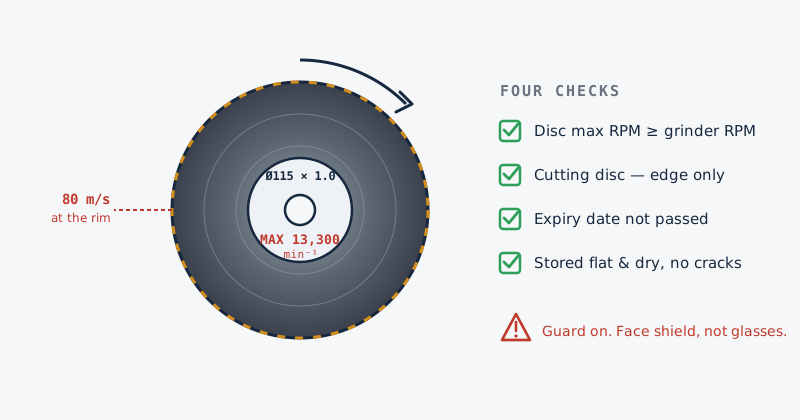
The rim of a 115 mm cut-off wheel spinning at its rated 13,300 RPM is travelling at about 80 metres per second — 290 km/h. There is no meaningful difference between a fragment of that disc and a bullet. This is the one product in the catalogue where getting the details right is not about tool life.
The good news is that abrasive discs almost never fail without a reason, and the reasons are few.
Check 1: the disc must be rated faster than your grinder
Every bonded abrasive disc is marked with a maximum operating speed. Every grinder is marked with a no-load speed. The disc number must be equal to or higher than the grinder number. Not close — equal or higher.
This is where the common accident happens: fitting a 180 mm disc onto a 115 mm grinder using an adaptor. The small grinder spins at 11,000 RPM; the large disc is rated for 8,500. It will burst, and usually within seconds.
| Disc diameter | Max RPM | Typical grinder |
|---|---|---|
| 100 mm (4") | 15,200 | 4" angle grinder |
| 115 mm (4.5") | 13,300 | 4.5" angle grinder |
| 125 mm (5") | 12,200 | 5" angle grinder |
| 150 mm (6") | 10,200 | 6" angle grinder |
| 180 mm (7") | 8,500 | 7" angle grinder |
| 230 mm (9") | 6,600 | 9" angle grinder |
Check 2: cutting discs cut. Grinding discs grind.
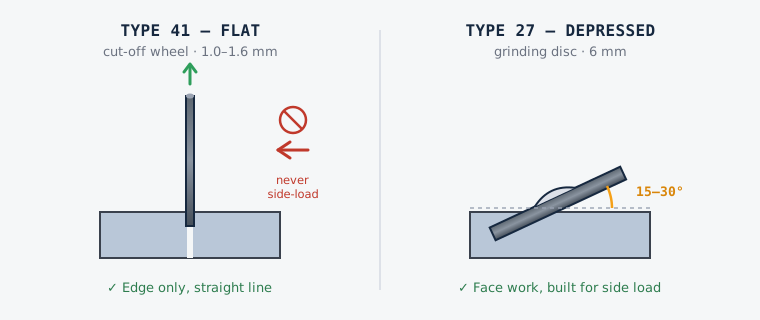
A thin cut-off wheel is reinforced to resist forces in its own plane, not across it. Using the side of a cutting disc to grind or deburr — or twisting it in the cut to change direction — loads it in exactly the direction it cannot take.
- Type 41 (flat) — cutting only, with the edge, in a straight line. If the cut binds, stop and free the workpiece; do not lever the disc out.
- Type 27 (depressed centre) — grinding, with the face, at 15–30° to the work. Thicker and built for side load.
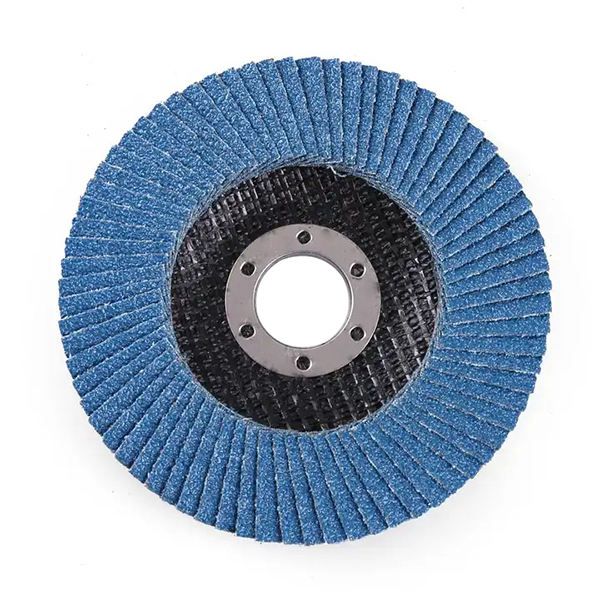
- Flap disc — surface finishing and blending. Kinder to thin sheet than a rigid grinding wheel because the abrasive flaps conform.
A very common site habit is cutting a slot then "cleaning it up" with the side of the same 1 mm disc. That is the moment discs come apart.
From our range
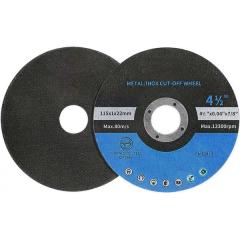
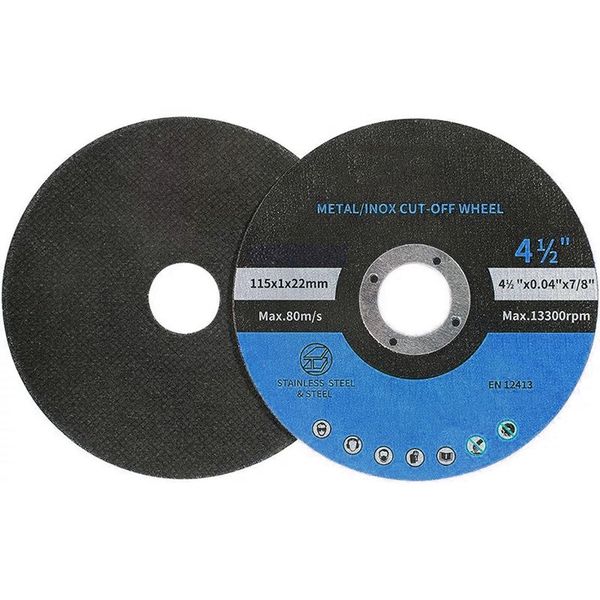
Industrial 4.5" (115mm) Ultra-Thin 1.0mm Cut-Off Wheel for INOX – OEM
1.0 mm ultra-thin INOX cutting disc — for straight cuts in stainless with minimal heat discolouration.
Check 3: the expiry date
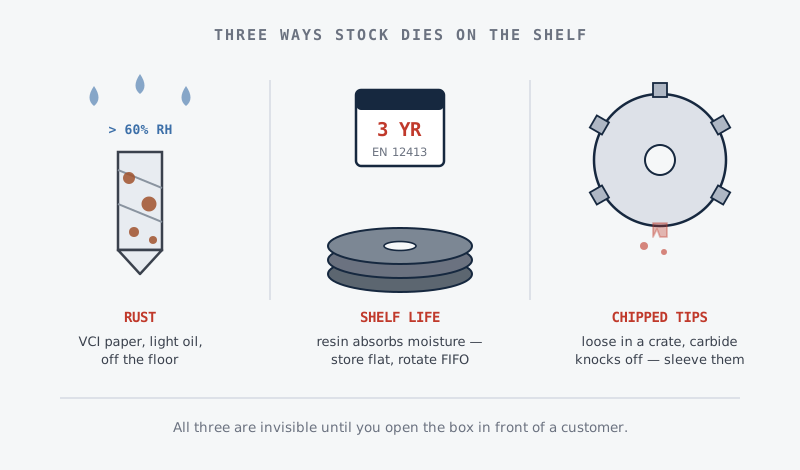
This one surprises people who have used discs for years. Resin-bonded abrasive wheels have a shelf life, and under EN 12413 they carry an expiry date on the label — normally three years from manufacture.
The reason is chemistry. The phenolic resin holding the abrasive grains together slowly absorbs atmospheric moisture. As it does, the bond weakens and becomes unpredictable. An eight-year-old disc that has sat in a damp container may look perfect and fail at full speed.
- Check the date stamp before fitting a disc from old stock.
- Rotate stock — first in, first out. This matters for distributors holding inventory as much as for end users.
- A disc that has been soaked, or stored in an unheated container through a humid season, should be scrapped regardless of date.
Check 4: storage and handling
- Flat and supported. Stacked flat on a shelf, or in the original box. Discs stored leaning against a wall take a permanent set and run out of true.
- Dry. Not on a concrete floor, not in an unheated shipping container, not near a wash bay. Moisture is the enemy of resin bond.
- No impact. A dropped disc gets an invisible edge crack. The rule on any well-run site is simple: a disc that hits the floor goes in the bin.
- Inspect before fitting. Look at both faces and the edge for chips, cracks and delamination of the fibreglass mesh. For thin resin discs, visual inspection is the check — the "ring test" you may have read about applies to thick vitrified wheels, not to reinforced cut-off discs.
Running the machine
- 01Guard on, positioned between the disc and your body.
- 02Face shield — not just glasses. Eye protection alone does not stop a disc fragment.
- 03Let the grinder reach full speed off the work before you touch the material.
- 04Cut in a straight line, let the disc do the work. Pushing harder does not cut faster; it just heats the disc and bends it.
- 05Support the workpiece both sides of the cut so the offcut cannot pinch the disc as it falls.
- 06Let it stop on its own. Do not put a spinning grinder down on the bench.
None of these checks take more than a few seconds. Together they cover the overwhelming majority of abrasive disc failures — and every one of them is a failure that was entirely avoidable.
Products mentioned in this guide
Cut-Off Wheels
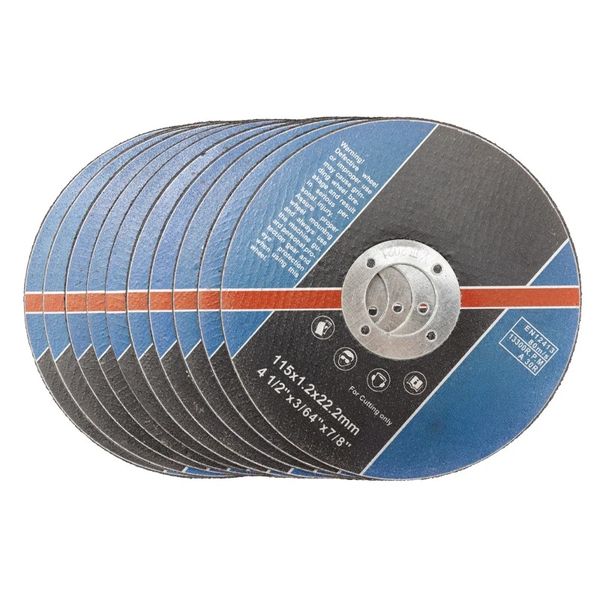
Industrial 4.5" (115mm) Resin Cut-Off Wheel for Stainless Steel – OEM
Cut-Off Wheels
Industrial 4.5" (115mm) Ultra-Thin 1.0mm Cut-Off Wheel for INOX – OEM
Grinding Wheels
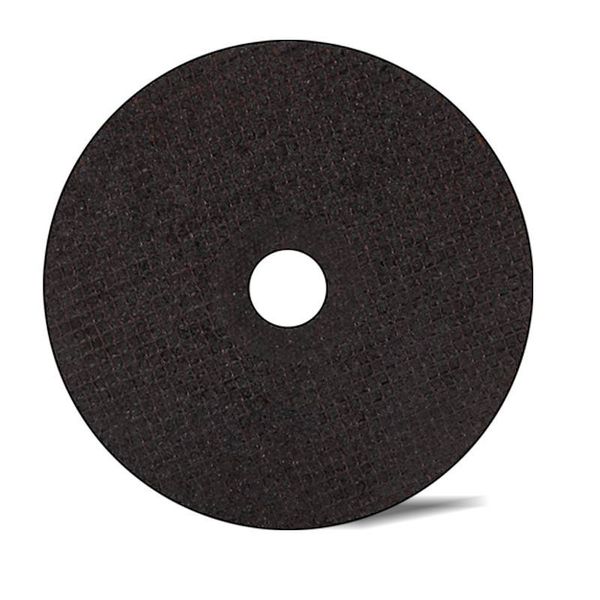
Industrial Aluminum Oxide Depressed Center Grinding Wheel for Metal (Type 27) – OEM
Flap Discs & Sanding