Free tool
Grinding Disc RPM Safety Check
A cut-off disc does not fail because it is cheap. It fails because someone put a 230 mm disc on a 180 mm machine and the rim went past 80 metres per second. Enter the disc and the grinder, and this tells you the rim speed, the margin, and whether to walk away.
Do not fit this disc — 102 m/s, 28% over its 80 m/s rating
The machine turns at 8,500 RPM but this disc is rated for 6,643 RPM. Resin discs are proof-tested to about 1.5× rated speed, and everything above the rating eats into that margin. A disc that bursts at 128% is not a freak event, it is the design being used up.
- Disc max RPM
- 6,600
- Your machine
- 8,500
- Rim speed
- 102.4 m/s
- Of rated limit
- 128%
What this machine can safely spin at 8,500 RPM (80 m/s discs)
The 80 m/s rule, in one line
A bonded abrasive disc is a ring of grit held together by resin, and the resin has a speed at which it lets go. For standard cut-off, grinding and flap discs that design ceiling is 80 metres per second at the rim. It is a property of the disc, not the machine, and it is the same for every diameter — so the RPM limit has to change with size:
Max RPM = 80 × 60,000 ÷ (π × D)
That is the whole safety system. It gives 15,300 for 100 mm, 13,300 for 115 mm, 12,200 for 125 mm, 8,500 for 180 mm, 6,600 for 230 mm. Angle grinders are built to sit just under the number for their own disc size — which is exactly why a disc from a bigger machine is dangerous on a smaller one, and never the other way round.
- The printed MAX RPM already includes the diameter. Compare it directly with the no-load speed on the grinder’s rating plate. Machine number must be equal or lower. No exceptions, no “it is only a bit over”.
- Colour stripes are the speed rating. Blue 50, yellow 63, red 80, green 100 m/s. Most angle-grinder discs are red; bench grinder wheels are often blue or yellow and belong on slow machines only.
- The guard is part of the rating. A disc that does not fit inside the guard is not “slightly oversize”, it is unguarded. Proof-tested discs still throw fragments at 1.5× rated speed; the guard is what stops those fragments reaching a person.
- Diamond blades and wire wheels obey the same rule. Anything that mounts on the spindle carries a max RPM, and it binds the same way.
Maximum RPM by disc size and speed rating
The 80 m/s column is what is printed on nearly every angle-grinder disc. The others are what the same diameter is allowed to do under a different colour stripe — the arithmetic is identical, only the ceiling moves.
| Disc Ø | Arbor | 50 m/s | 63 m/s | 80 m/s | 100 m/s | Typical machine |
|---|---|---|---|---|---|---|
| 76 mm 3" | 10 mm | 12,600 | 15,800 | 20,100 | 25,100 | Mini / cordless grinders |
| 100 mm 4" | 16.0 mm | 9,500 | 12,000 | 15,300 | 19,100 | Compact grinders — India & SE Asia |
| 115 mm 4½" | 22.23 mm | 8,300 | 10,500 | 13,300 | 16,600 | One-hand grinders — Middle East, Europe, Africa |
| 125 mm 5" | 22.23 mm | 7,600 | 9,600 | 12,200 | 15,300 | One-hand, more reach — the global all-rounder |
| 150 mm 6" | 22.23 mm | 6,400 | 8,000 | 10,200 | 12,700 | Between classes; fabrication shops |
| 180 mm 7" | 22.23 mm | 5,300 | 6,700 | 8,500 | 10,600 | Two-hand grinders — heavy fabrication |
| 230 mm 9" | 22.23 mm | 4,200 | 5,200 | 6,600 | 8,300 | Two-hand — structural steel, masonry |
| 300 mm 12" | 20 / 25.4 mm | 3,200 | 4,000 | 5,100 | 6,400 | Cut-off saws, petrol saws |
| 355 mm 14" | 25.4 mm | 2,700 | 3,400 | 4,300 | 5,400 | Chop saws, petrol cut-off saws |
| 400 mm 16" | 25.4 mm | 2,400 | 3,000 | 3,800 | 4,800 | Large petrol saws, wall saws |
RPM = v × 60 000 ÷ (π × D), rounded to the nearest 100 as manufacturers print it. A 230 mm disc at 8,500 RPM runs 102 m/s — that is the number the rule protects you from
Common questions
Can I use a 125 mm disc on a 115 mm grinder?+
What does 80 m/s on a grinding disc mean?+
What is the maximum RPM for a 4.5 inch cutting disc?+
What RPM is a 9 inch angle grinder?+
Can I put a smaller disc on a bigger grinder?+
How do I know if a cutting disc has expired?+
Related guides
From our range
Discs rated, marked and dated the way this page describes
80 m/s cut-off wheels from 1.0 mm INOX to 3.0 mm, Type 27 grinding wheels, zirconia flap discs and diamond blades — every one printed with max RPM, expiry and the correct bore for your market. Factory-direct, OEM/ODM, mixed containers.
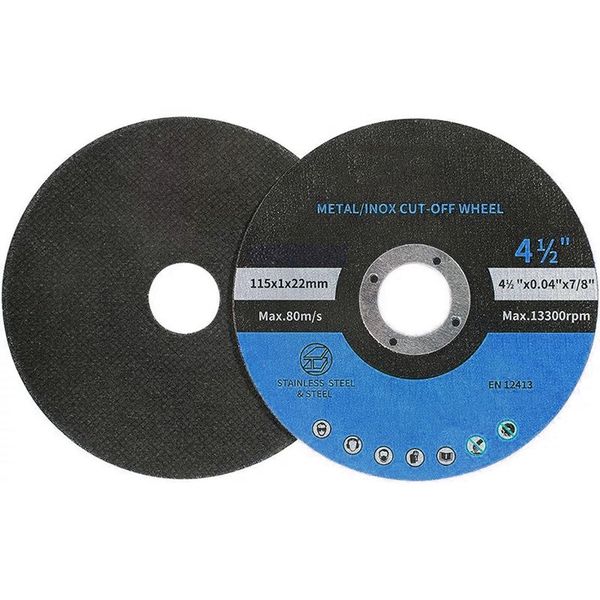
Cut-Off Wheels
Industrial 4.5" (115mm) Ultra-Thin 1.0mm Cut-Off Wheel for INOX – OEM
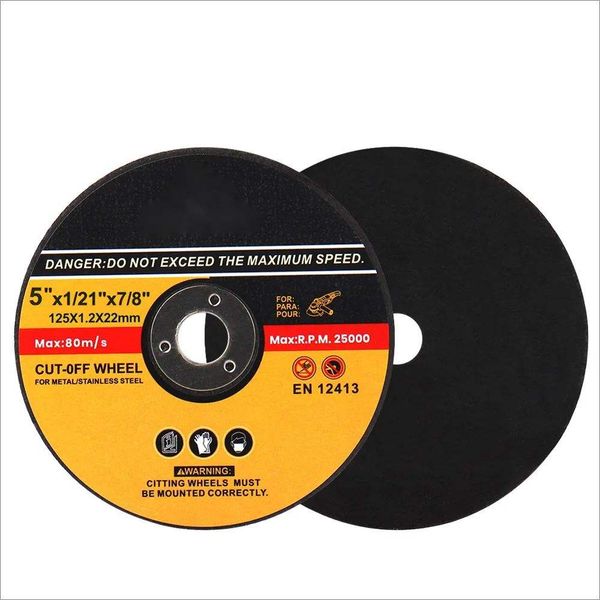
Cut-Off Wheels
Industrial 5" (125mm) Resin Cut-Off Wheel for Stainless Steel – OEM
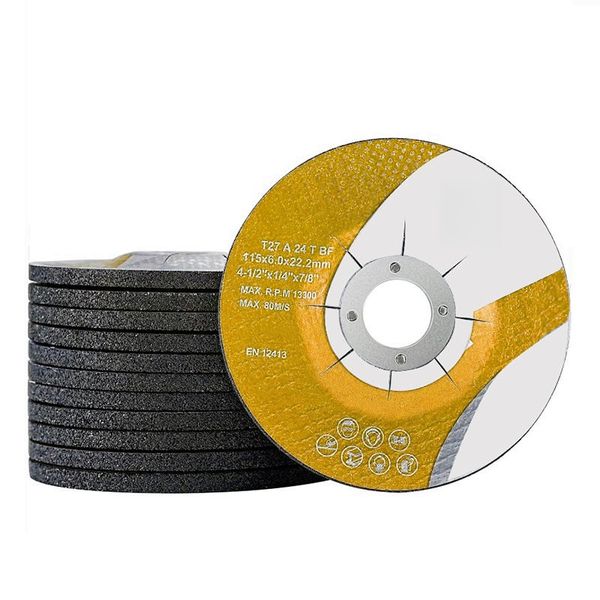
Grinding Wheels
Industrial 4.5" (115mm) Depressed Center Grinding Wheel for Metal – OEM
Grinding Wheels
Industrial Aluminum Oxide Depressed Center Grinding Wheel for Metal (Type 27) – OEM
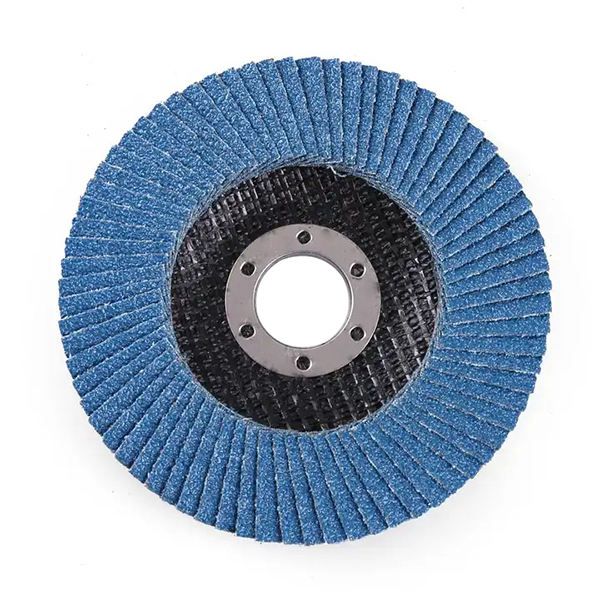
Flap Discs & Sanding
Industrial 4.5" Zirconia Flap Disc for Stainless Steel & Metal – OEM
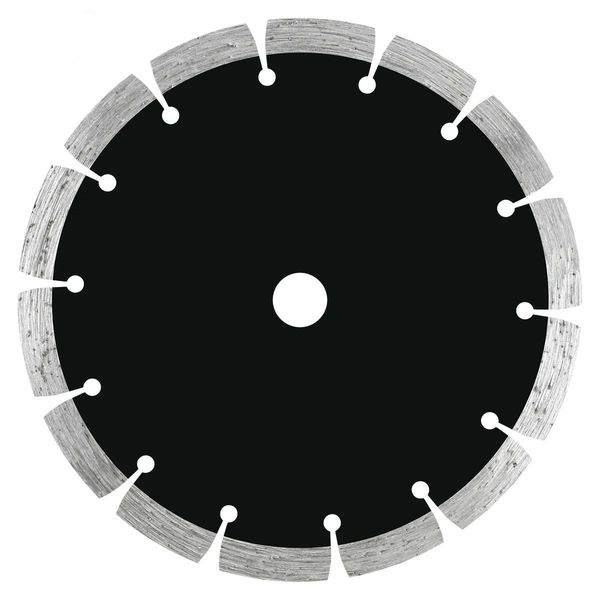
Diamond Blades